Beyond gold: Who rules India’s $85 billion jewellery market?
By
Shilpa Dhamija Updated 24 May, 2026 • Published 23 Mar, 2026
Valued at $85 billion (₹7.31 lakh crore), India’s domestic gems and jewellery market is the lifeline of its luxury market. Luxury Volt reveals how this vast industry has transformed from an unorganised trade into one of India’s most lucrative consumer markets, and why global jewellery giants still struggle to break in.
India's gems and jewellery market size is $85 billion in 2026
FREE NEWSLETTER & ACCOUNT
Top luxury news, expert insights, and exclusive luxury market intel
India is the world’s biggest consumer of gold jewellery. Bigger than China. For natural diamond jewellery, India ranks second only to the United States. In 2026, India’s gems and jewellery market is valued at about $85 billion (₹7.31 lakh crore).
Luxury Volt explainer: The evolution of India’s precious jewellery market
Although India’s jewellery trade dates back centuries, its corporatisation started only in the late 1990s. Before that Indians shopped for gold at mom-and-pop local stores. Titan was the first to disrupt India’s hyper-local consumption habits, and introduce organised retail in the jewellery sector with the launch of its maiden jewellery retail brand – Tanishq. Titan championed transparent pricing and a nationwide retail network which was an overdue and an evolutionary shift for the Indian market.
Tanishq’s rapid popularity shifted consumer loyalty to branded retail and forced regional players to adopt corporate structures, forever changing how India buys jewellery.
Emboldened by Tanishq’s success, regional players also began transforming their small operations into nationwide retail chains. The majority of these brands emerged from South India, particularly Kerala state, a historically significant hub for gold consumption. Today, Kerala is the base of most of India’s biggest jewellery retailers. Moreover, they are expanding their reach far beyond the country’s borders.
While India’s precious jewellery market is big enough to benefit both domestic and global brands, domestic brands continue to dominate the market across price points and prestige tiers. From mass-market retailers to high-jewellery labels, India’s jewellery ecosystem remains predominantly local, making it difficult for international marquee brands to gain meaningful traction despite their global appeal.
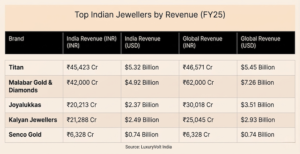
Here are India’s top 5 jewellers that dominate the jewellery market. Most of them started in the late 1990s and have expanded to hundreds of stores across India and beyond. All of these brands cater to various price and prestige segments.
India’s top jewellers
1) Malabar Gold and Diamonds is India’s largest, independently owned jewellery group. With a turnover of $7.36 billion, Malabar Gold and Diamonds is the world’s 5th-largest jewellery retailer. While domestic sales generate 68% of its revenue, global sales account for about 32%. Malabar Gold and Diamonds has over 420 showrooms across 14 countries including Middle east, North America and Australia.
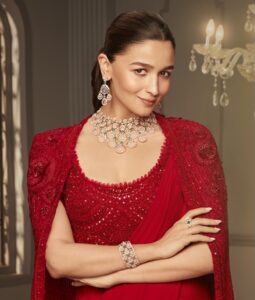
M.P. Ahammed founded Malabar Gold & Diamonds in 1993 in India’s southern state – Kerala. It offers a wide variety of jewellery – from traditional designs to diamond jewellery, high-jewellery and light weight pieces. Alia Bhatt, Gucci’s global Indian brand ambassador is also a global ambassador for Malabar Gold and Diamonds.
Indian actress Alia Bhatt is global ambassador of Malabar Gold & Diamonds – India’s biggest jewellery brand
Beyond its jewellery business, the Malabar Group operates in 14 other sectors, including real estate, electronics. More than 4,000 shareholders, including founders, investors, and management jointly own the group.
2) Titan is the watch and jewellery division of the Tata group. It includes four jewellery brands – Tanishq, CaratLane, Zoya and beYon. In FY 2025, Titan’s jewellery revenue reached ₹46,571 crore ($5.45 billion), fuelled mostly by the domestic market. Tanishq was launched by Titan in 1994–95. It was initially established to export made-in-India jewellery. In 1995, it pivoted to the domestic market, introducing an organised retail experience.
Tanishq- Tata’s flagship brand is known for traditional and contemporary gold and diamond jewellery.
CaratLane focuses on modern, affordable, and lightweight jewellery for everyday use. It has an omni-channel presence. Titan acquired a 100% stake in CaratLane in 2024.
Zoya is positioned as a luxury boutique brand that offers high-end, artistic designs.
Mia by Tanishq is an entry level jewellery brand where jewellery starts at about 1300 INR ($14) for silver jewellery. The brand offers low gold karate jewellery as well. Titan prices Mia by Tanishq jewellery between $14 and $4000..
beYon: A lab-grown diamond brand launched in 2025.
3) Kalyan Jewellers was also founded in the gold dominant market of Kerala. It was established in 1993 by T.S. Kalyanaraman in Thrissur city. He transitioned from a family business of textiles to jewellery retail, growing it into a multibillion-dollar empire. Kalyan now has over 250 showrooms across India and the Middle East with a strong focus on the wedding and festival jewellery segments. In 2017, Kalyan jewellers added a entry-level jewellery brand – Candere. to its portfolio.
Kalyan jewellers FY 2025 revenue was ₹25,045 crore (roughly $2.93 billion). 85% of its sales were generated in India.
Global & domestic revenue of India’s top 5 jewellery groups
4) Joyalukkas: Alukka Joseph Varghese originally founded the Alukkas jewellery brand in Thrissur city, in the southern Indian state of Kerala, in 1956. In 1987, his son, Joy Alukkas expanded the business internationally starting with Abu Dhabi in the UAE. The brand currently has 190+ showrooms in 12 countries. In the financial year ending March 2025, Joyalukkas recorded a revenue of $3.5 billion (₹30,018 crore) of which 67% was from the India market.
5) Senco Gold and Diamonds: Shankar Sen founded Senco Gold and Diamonds in 1994 in Kolkata, West Bengal in western India. Since then, the brand’s domestic network has grown to about 200 showrooms and 100 shop-in-shops. In FY 2025, its consolidated revenue was $740.68 million (₹6,328.07 crore) through sales in India.
1.INR to USD exchange rate used for conversion is 1USD = ₹85.44 as of 31st March 2025.
FAQs
Who is India's single largest jeweller? +
India’s single largest jeweller by value is ‘Malabar Gold and Diamonds’. It is a privately owned company. Malabar has a world wide retail network ranging from the Middle-east to New-Zealand. It recorded a turnover of a turnover of $7.36 billion in financial year 2025
Do India's top jewellers only sell wedding jewellery? +
No, India’s top jewellers don’t sell only wedding jewellery. For many of the top jewellers, wedding jewellery makes less than 50% of their sales. Indians favour local jewellers even for non-wedding jewellery due to trusted relationships.
Shilpa is a world renowned journalist and an expert in decoding India and Asia’s luxury markets for global readers. Her original, in-depth reports and analysis are frequently featured in prestigious international titles across the UK, China, Hong Kong, Switzerland, and Oman.
India is cutting import duties on many luxury goods; cars, watches, cosmetics & wines through new trade deals with the EU, UK, UAE, Switzerland and Australia. Lower taxes will boost demand of foreign luxury goods in India, encouraging more global brands to enter and expand in the market.
At key global red carpet events, Alia Bhatt has out-ranked icons like Zendaya and Kendall Jenner, while generating multi-million dollar EMV for brands like Gucci & L’Oréal. Discover how the Indian actress strategically built her influence from a teenage movie star to an ROI magnet from south Asia.
India is significantly reducing import duties on alcoholic beverages and liquor – premium wines, whisky, beer, rum, vodka and tequila – as part of new trade deals with the UK, EU, Australia, New Zealand, Switzerland and Finland. See which major alcobev brands and spirits will benefit the most.
His watches are priced at an average $100,000 and yet attract a long waiting list of buyers. Even Chanel has acquired a stake in his company. He has won every major watch industry award in the world. Meet Maximilian Büsser, the Swiss-Indian watchmaker and founder of the unconventional watch brand MB&F
DLF is a leading luxury real estate and retail developer in India. DLF built India’s first dedicated mall for luxury brands. It currently runs 2 luxury malls in the national capital region (NCR). DLF also makes ultra-luxury homes, some of which are among the most expensive in India.
Aditya Birla Fashion Retail Ltd. (ABFRL) is India’s single largest pure-play fashion conglomerate. It is India partner of Galeries Lafayette and Christian Louboutin. ABFRL owns a majority stake in India’s most valuable luxury brand - Sabyasachi. Other Indian luxury and premium fashion brands in its portfolio are - Tarun Tahiliani. Shantnu & Nikhil, Masaba and Jaypore.
Reliance Brands Limited (RBL) is the premium and luxury retail powerhouse of the Reliance Industries conglomerate. It is the India partner for global brands such as Balenciaga, Bottega Veneta, Burberry, Giorgio Armani, Tiffany & Co., Valentino, and Versace. It also holds significant stakes in leading Indian designers like Manish Malhotra and Abu Jani Sandeep Khosla.